Virtual event production services cover everything that turns a video call into a broadcast: a dedicated producer running the show, presenter tech checks before the day, branded graphics, live switching between speakers and slides, stream delivery to your platform, and a clean recording afterward. You bring the speakers and the content. The production team handles every technical decision so nobody on camera has to think about one.
I'm Mark White, owner of DFW Live Stream. I've spent the last ten years producing live streaming and video for corporate events, conferences, and universities, and these days a big share of that work never involves a venue at all — it's fully virtual, produced remotely, for clients anywhere in the US.
This is the plain-English breakdown of what you're buying when you hire virtual event production services: what's included line by line, what it costs with real numbers, and where the scope stops. If you're earlier in the process and still deciding who to hire, I wrote a separate guide on what a virtual event production company actually does — this one is about the service itself.
Every virtual event production company packages things a little differently. But the pieces below are the job. If a proposal is missing one of them, that's not a cheaper version of the same service — it's a different service.
This is the whole product, honestly. Everything else is equipment.
A producer sits at the controls for the entire event with one job: your show. They're cutting between speakers, pulling up slides, rolling video, watching audio levels, and catching problems before your audience ever notices them. When a presenter's camera freezes, someone is already switching away from it.
The alternative is the version most companies live with — somebody on the marketing team is presenting and producing at the same time, sharing the wrong screen, and apologizing for it live.
Good online event production starts days before anyone goes live. Every presenter gets tested: camera, microphone, lighting, internet connection, screen sharing.
We send speakers a prep guide and walk through it with them. Ten minutes on a tech check saves you the moment where a VP joins from a dark room with laptop audio while 400 people watch.
For events with a lot of presenters, this is also where the run of show gets built — the segment-by-segment plan for who's on when, what's on screen, and how handoffs happen.
Your virtual event should look like it belongs to your brand, not to whatever software you're streaming through.
That means lower thirds with names and titles, a branded backdrop behind your speakers, intro and outro cards, holding slides for the pre-show, and transition graphics between segments. We build these once in pre-production, and every event you run after that opens the same way.
Live switching is what separates a produced virtual event from a webcam grid. Instead of everyone staring at the same static layout for ninety minutes, the picture changes with the content — full-screen speaker, speaker with slides, two-box for a conversation, full-screen video when you roll a clip.
Pre-recorded content gets rolled on cue instead of someone sharing a video player and hoping the audio comes through. Slides come in clean rather than as a shrunken window with a taskbar visible at the bottom.
The stream has to land somewhere, and that somewhere is your call. Zoom, Microsoft Teams, YouTube, Facebook, Vimeo, or embedded directly on your own site — we produce into whatever platform your audience already uses, on your accounts, so you keep your data and your registrations.
Platform management is part of the service: configuring the event, setting up the interactive features, testing the delivery path, and monitoring the stream the way a viewer sees it while the show is running. If you're still deciding, here's my breakdown of how to choose a streaming platform for a corporate event.
You should walk away with a clean recording of the program feed — the switched, produced show with the good audio mix, not a raw grid capture of a video call.
From there it's optional: short vertical clips for social, a chaptered replay for on-demand viewing, or the platform's attendance and watch-time numbers. Ask any vendor exactly which file you get and when. "We'll send the recording" means five different things depending on who says it.
Most of this industry hides pricing behind a contact form. We publish ours, so let me just put the numbers on the table.
A single produced webinar or virtual session, up to 90 minutes live, is $1,385. That covers the producer, the pre-production session, your branded graphics, presenter tech checks, live production, and the recording.
If you run them regularly, monthly production is $885 per month for one event a month, or $1,585 per month for two — the setup work spreads across the relationship instead of landing on a single show.
Longer programs — 2 to 3 hours, panels, multi-segment agendas, half-day formats — run $1,985. A clips pack adds 3 to 5 vertical social cuts for $285.
All of that is on the packages and pricing page, and the price on the card is the price.
The published tiers cover the format most companies actually run: one or two speakers, up to 90 minutes, single track. Once you're past that, it's a different animal and it gets scoped individually.
An all-hands with eight presenters needs rehearsals with all eight. A multi-session virtual conference with breakouts is effectively several productions running at once. Those get quoted as custom engagements rather than squeezed into a package, and honestly, most virtual event production companies that publish anything at all put multi-session work well into five figures.
What I'd tell you on a call: for a full-day virtual conference, plan for real money. For a produced town hall with a handful of speakers, less than you probably think.
Four things, in order of impact. How many presenters need prep and rehearsal. How long the program runs. How many simultaneous sessions or tracks you need. And how much of the content is pre-recorded and edited versus live.
What barely moves it: which platform you're on, and how many people watch. Streaming to 200 people costs the same as streaming to 2,000.
This is the distinction that saves everyone a wasted call.
Production services mean you bring the audience — your list, your members, your customers — and we make the show look and sound professional. Full-service virtual event agencies also build registration pages, run promotional campaigns, and own attendance strategy, and they charge several times more because that's a much bigger scope.
If you already have an audience, an agency is overkill. If you have no audience, production alone won't fill the seats. Most corporate teams I work with already have the list and just need the show to stop looking like a conference call.
A virtual event is fully remote — presenters join from wherever they are, and there's no room. That's what these services cover, and there's no travel in the price.
The moment you add an in-person audience, it becomes a hybrid event: cameras in the room, on-site crew, room audio, and a second experience to design. That's priced as on-site event production, and it starts around $3,900 for a single day. I've written up what hybrid event production actually takes if that's where you're headed.
Plenty of clients run both — virtual all year, hybrid for the annual meeting.
You're not buying equipment, but it's fair to ask what's running the show.
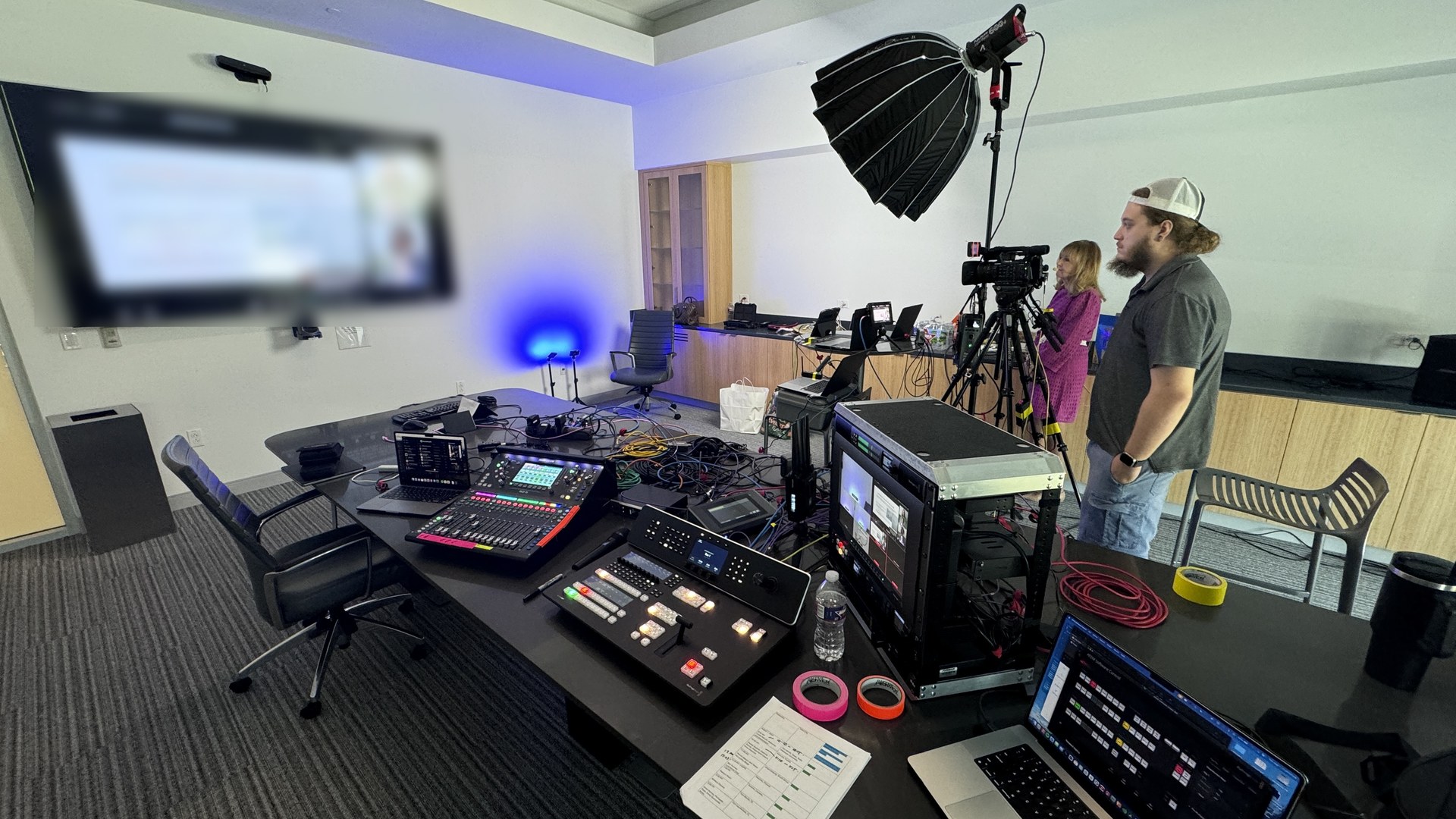
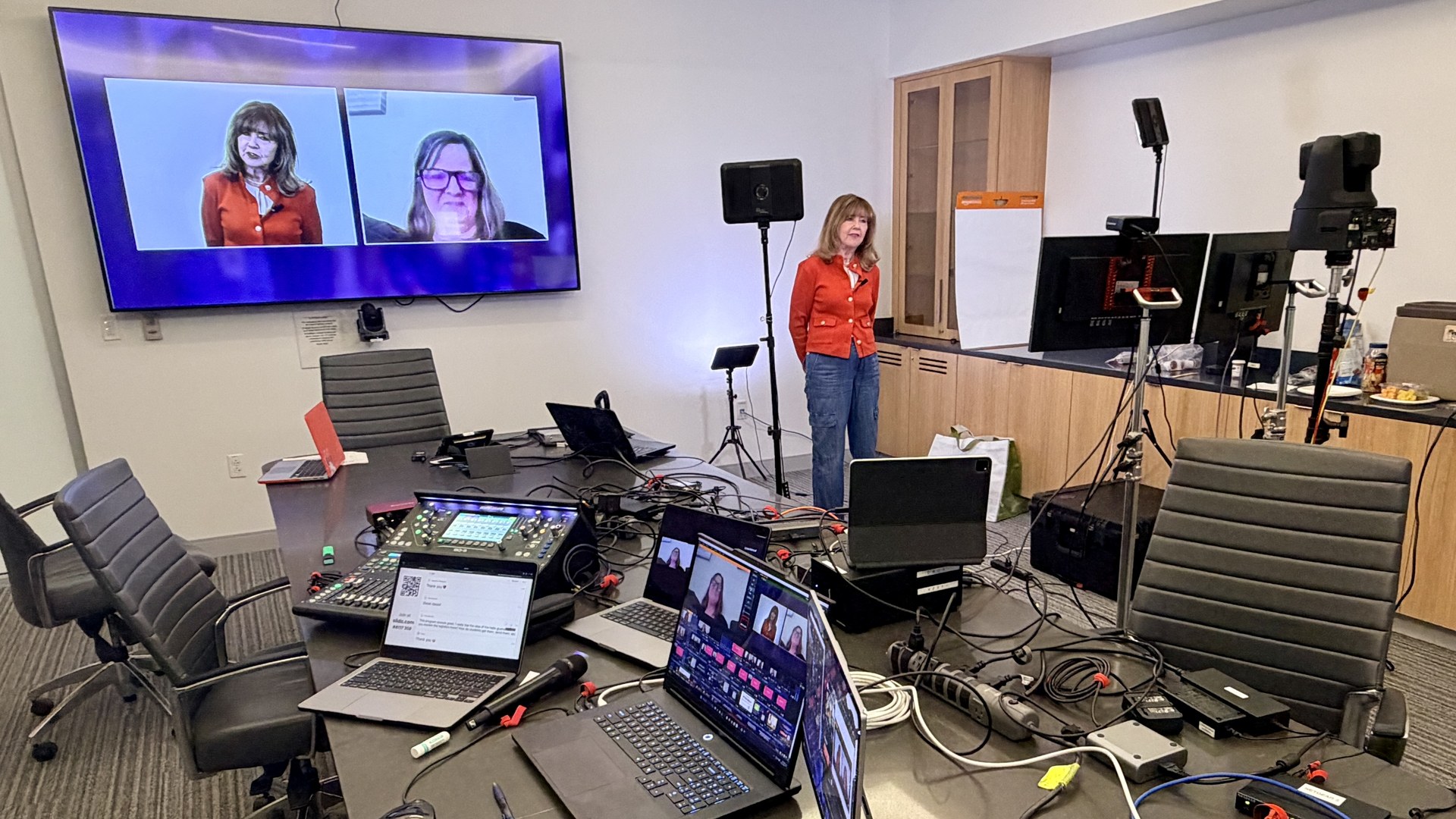
Our virtual productions run through Blackmagic ATEM switchers for live switching and graphics, with an Allen and Heath SQ5 handling audio when a session needs real mixing. When a session includes anyone on camera in a studio, we're shooting on Canon CR-N500 PTZ units with Sennheiser wireless audio. For anything with an on-site component, a LiveU Solo Pro gives the stream a bonded cellular path so it doesn't depend on venue internet.
The gear matters less than the person operating it, which is the same reason a news broadcast doesn't look good because of the cameras.
Four questions worth asking any virtual event production company before you sign anything.
Who is at the controls during my event? You want a named producer whose only job that day is your show — not a support ticket queue.
What happens in pre-production? If nobody wants to talk through your run of show in advance, every problem gets discovered live.
What do we own afterward? The recording should be yours, in a usable format, without a ransom fee.
And what happens when something breaks? Everyone has a story. The ones worth hiring answer it in specifics — backup paths, redundant recording, what they did the last time a presenter's internet died mid-sentence.
If you're weighing whether to build this capability internally instead, I compared both paths in in-house versus outsourced production.
If you've got a virtual event coming up and want to know what it would actually take — how many presenters need prep, what the run of show should look like, where your budget lands — grab a short call and I'll tell you straight. If we're not the right team for it, I'll say that too, and point you at who is.
A dedicated producer running the live show, pre-event tech checks and rehearsals with every presenter, branded graphics, live switching between speakers and content, video playback, stream delivery to your chosen platform, live monitoring, and a recording of the produced program afterward.
Our published pricing starts at $1,385 for a single produced session up to 90 minutes, $885 per month for a monthly program, and $1,985 for extended 2 to 3 hour formats. Multi-presenter all-hands and multi-session virtual conferences are scoped individually and land higher.
You don't need one to hold the meeting. You need one when the event matters enough that it should look produced — a customer-facing launch, an all-hands, a paid session. The platform hosts the call; production is what makes it a show.
No. Virtual is fully remote with no in-person audience, so there's no crew travel or room gear in the price. Hybrid adds an on-site audience, cameras in the room, and room audio, which is why hybrid production starts around $3,900 per day and virtual doesn't.
Zoom, Microsoft Teams, YouTube, Facebook, Vimeo, or an embed on your own website. We produce on your platform accounts so registrations, data, and recordings stay with you.
Two to three weeks is comfortable for a single session — enough time for a pre-production call, graphics, and tech checks with your presenters. Multi-session conferences want a month or more. We've turned events around faster, but the rehearsal time is what makes the day boring in the best way.
No. A computer, a webcam, and a decent microphone. Presenters join through a normal video call — no special links, downloads, or drivers — and everything that makes it look produced happens on our end.
Yes, and most of ours are. Virtual event production happens wherever the producer is, so location stops mattering — we work with organizations in every US time zone without anyone traveling. Geography only comes back into it when there's a physical room involved.